What CRM means for a small venue
CRM stands for customer relationship management. In a company with salespeople it tracks deals. In a venue with a counter it is a list of your customers with what you know about each one: their name and contact, when they come, what they have collected, and whether they agreed to hear from you.
The point of it is three questions you can’t answer from the till alone: who are my regulars, who stopped coming, and how do I tell them something.
What it should hold
A CRM for a venue doesn’t need much. It needs these five things to be reliable:
- One record per person, with a phone number or an email.
- Their visits or purchases, with dates.
- What they hold: points, stamps, a level, a prepaid pass.
- Their consents: the privacy policy, and separately news and offers.
- A way to write to them — one person, a group, or everyone who agreed.
Where the data comes from
This is where most small venues get stuck. A CRM is only as good as its data, and nobody at a busy counter types customers into a spreadsheet. The data has to appear by itself, from something customers already do.
In a salon that is the booking: a booking system knows who came and when. In a café or a shop there is no booking, so the natural source is the loyalty card: a customer signs up once to get it, and every stamp or purchase after that is recorded with the card. The program fills the CRM as a side effect.
CRM and loyalty program: one thing or two?
A loyalty program gives customers a reason to come back and to identify themselves at the counter. A CRM is what you learn and do because they did. Services for venues usually sell both together for that reason: the card collects, the CRM uses.
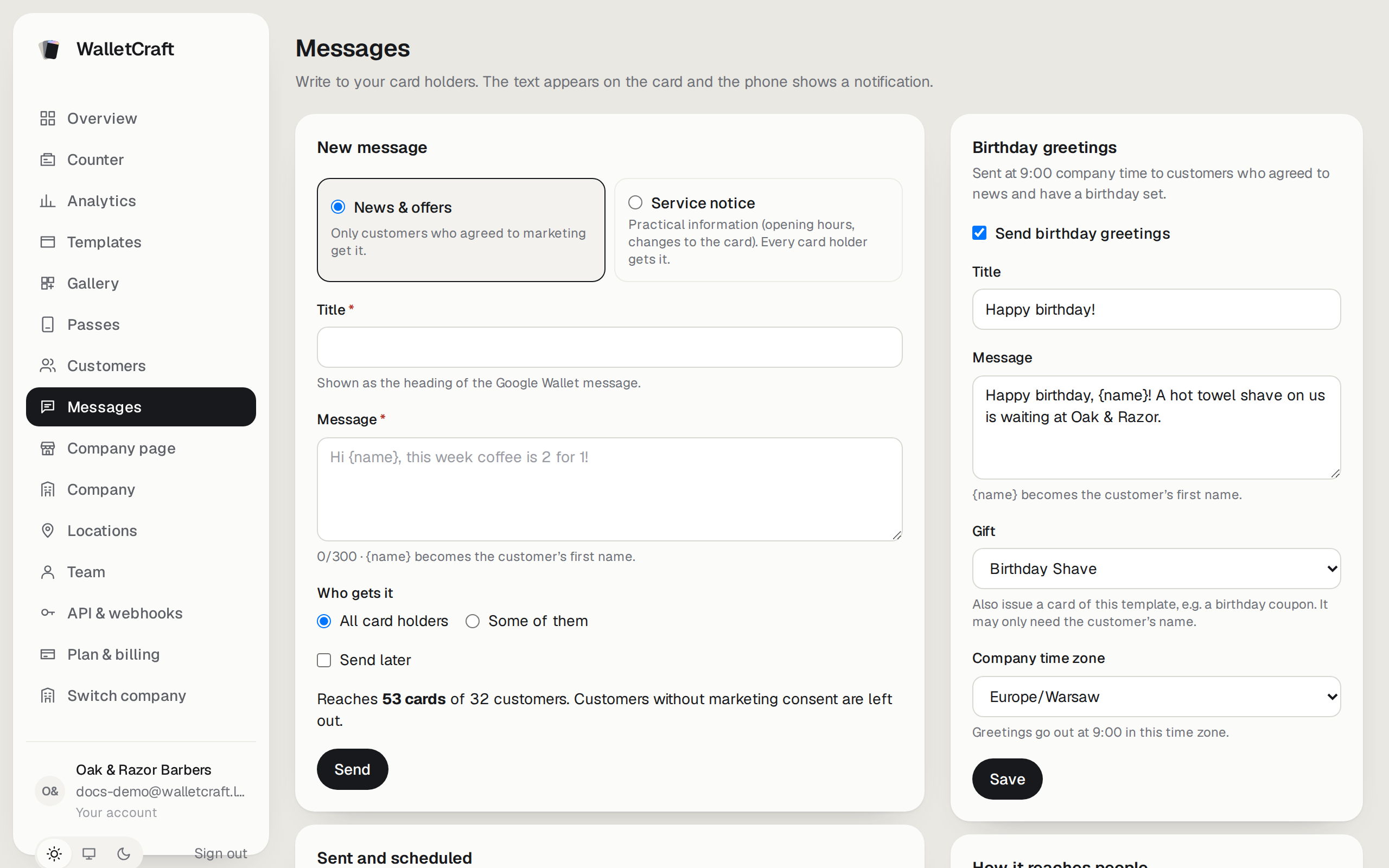
In WalletCraft the loyalty card lives in Apple Wallet or Google Wallet, and the customer base behind it is a simple CRM: each customer with their cards, visits, purchases and consents, tags and notes, messages to the card and the lock screen, birthday greetings, and a reminder for people who stopped coming.
What to do with it in the first month
- Get regulars onto the card: a QR code at the counter and one sentence from the staff.
- After two or three weeks, look at who came more than once. Those are your regulars.
- Send one useful message to people who agreed to news — a new item, changed hours, a quiet-day offer.
- Turn on birthday greetings, with a small gift if you like.
- After a month, write to those who haven’t been back.
When you don’t need one
If you already use a booking system that keeps your clients and lets you write to them, you have a CRM; a second one would only split your data. And if almost all your customers are passers-by who come once — a kiosk at a station — there are no relationships to manage. A CRM pays off where people can come back.